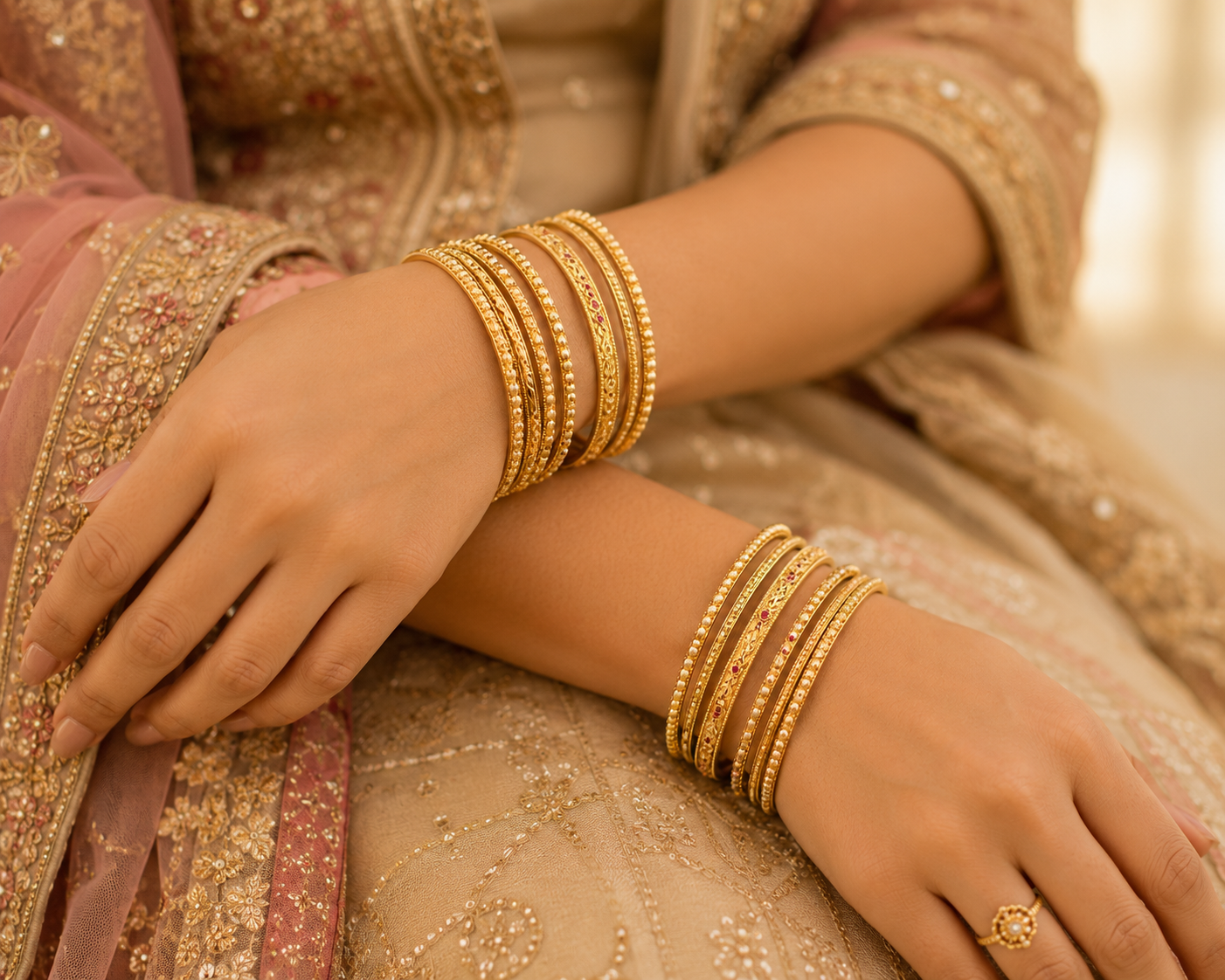
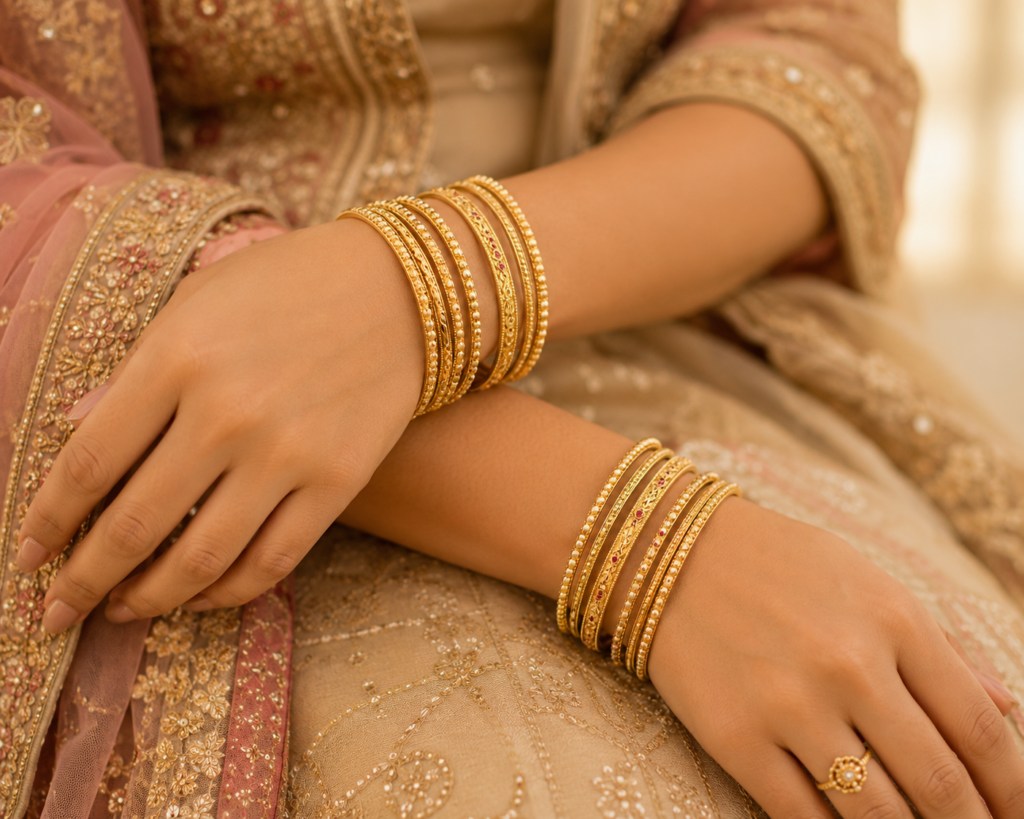
Indian Gold Bangles: The Ultimate 2026 Buyer’s Guide for Women in the USA
Did you know that India is the world’s second largest consumer of gold, with Indian women collectively wearing billions of dollars worth of gold bangles every single year? If you have ever searched for gold bangles Indian style and felt overwhelmed by the options, the prices, or the meanings behind each design, you are not alone. Millions of women across the USA are discovering these timeless pieces for the first time, or returning to them after years away from their heritage.
Gold bangles Indian women wear are far more than jewelry. They carry centuries of history, regional identity, and deep personal meaning. Yet they are also one of the most wearable, stylish, and investment-worthy accessories you can own today.
In this guide you will learn exactly what makes Indian gold bangles unique, how much they cost in India and the USA in 2026, which designs are trending right now, why Indian women wear them, how to buy them safely, and what separates West Indian gold bangles from their South and North Indian counterparts. By the end, you will know everything a first-time buyer or seasoned collector needs.
Table of Contents
- What Are Indian Gold Bangles and Why Are They Special?
- Why Do Indian Women Wear Gold Bangles?
- Indian Gold Bangles Design: A Region-by-Region Breakdown
- How Much Do Gold Bangles Cost in India in 2026?
- What Is the Price of Indian Gold Bangles in the USA?
- Gold Bangles Patterns India: The Most Popular Styles Right Now
- How to Buy Indian Gold Bangles Without Getting Burned
- Frequently Asked Questions
What Are Indian Gold Bangles and Why Are They Special?
Indian gold bangles are rigid, circular wrist ornaments crafted primarily in 22 karat gold. They differ from Western bracelets in both construction and meaning. Where a Western bracelet often clasps open and closed, a traditional Indian gold bangle slides over the hand and sits on the wrist without any hinge or fastening. This simple design has remained virtually unchanged for over 5,000 years.
The history of Indian gold bangles goes back to the Indus Valley Civilization. Archaeologists excavating Mohenjo-Daro uncovered a bronze figurine of a young woman wearing bangles on one arm, dating back to approximately 2500 BCE. That single artifact tells us something powerful: Indian women have been adorning their wrists with bangles for longer than most modern civilizations have existed.
What truly separates Indian gold bangles from the rest of the world is the craftsmanship. Each piece reflects a regional identity. A bangle made in Rajasthan looks completely different from one made in Tamil Nadu, even if both are pure 22 karat gold. The engraving styles, the motifs, the weight distribution, and even the finish are distinct enough that experienced jewelers can identify a bangle’s origin just by looking at it.
Additionally, these bangles hold financial significance. Unlike Western fashion jewelry, gold bangles Indian families pass down are real assets. Jewelry owners can easily sell them, reshape them, or create new jewelry from them Many Indian women treat their bangle collection as a form of savings, one that grows in value alongside the international gold market.
Why Do Indian Women Wear Gold Bangles?
Indian women wear gold bangles for cultural, spiritual, and practical reasons that generations have woven into their traditions over thousands of years.
The word bangle itself comes from the Sanskrit word “bangri” or “bangali,” which literally translates to “the ornament that adorns the arm.” That etymology alone tells you this is not a casual accessory. It is a defined category of adornment with its own name, its own rules, and its own deep symbolism.
Bangles as a Symbol of Marriage
For married women in India, gold bangles function much like a wedding ring does in the West. Wearing them signals marital status, health, luck, and prosperity. According to tradition, a newly married woman should never have bare wrists. The sound of bangles clinking together is considered auspicious. It is believed to repel negative energy and invite positivity into the home. Furthermore, in Sikh tradition, a woman is not supposed to purchase her own bangles as a bride. They must be gifted to her, further underscoring the relational and ceremonial weight these pieces carry.
Regional Bridal Bangle Traditions
Different regions of India have their own specific bangle rituals for brides:
In Punjab, new brides wear a set called “chooda,” which consists of red and white bangles that are worn for several months after marriage.
In Bengal, brides wear three specific bangles together. The shankha is a white bangle made from conch shell. The pola is a red bangle made from coral. The loha is an iron bangle representing protection and commitment.
In Maharashtra, brides stack green glass bangles alongside heavy gold patlya and sculpted tode bangles, representing fertility and abundance.
In South India, gold bangles for women are essential bridal ornaments. Families gift them at weddings as a blessing from the goddess Lakshmi. Wearing them in odd numbers is considered particularly auspicious in states like Andhra Pradesh and Telangana.
In Rajasthan and Gujarat, brightly colored lac bangles with mirror work and intricate motifs are common at weddings and festivals like Navratri.
The Scientific Angle Competitors Miss
Here is something most articles on Indian gold bangles never mention. Ayurveda and traditional Indian medicine have long held that wearing gold on the wrists helps regulate blood circulation and body energy. The constant gentle pressure of bangles on the wrist is believed to stimulate acupressure points. Whether one accepts this scientifically or culturally, it speaks to how deeply integrated these objects are into everyday life. They are not worn only on special occasions. Many Indian women, especially in rural and semi-urban India, wear gold bangles every single day.
Beyond Marriage: Fashion and Investment
Younger Indian women today wear gold bangles Indian designs for reasons that go far beyond marriage traditions. Social media, especially Pinterest and Instagram, has driven a massive revival of traditional Indian jewelry among millennials and Gen Z audiences in both India and the Indian diaspora in the USA. Stacking thin gold bangles in mixed patterns, pairing them with Western outfits, or mixing Indian gold bangles with minimalist cuffs has become a recognized style statement across New York, Los Angeles, Chicago, and Houston.
Indian Gold Bangles Design: A Region-by-Region Breakdown
Indian gold bangles design is one of the richest and most diverse categories in all of jewelry. Understanding regional styles helps you make a smarter purchase and choose a bangle that genuinely reflects the aesthetic or tradition you want.
North Indian Gold Bangles Designs
North India, particularly Rajasthan and Uttar Pradesh, is famous for gold bangles with meenakari work. Meenakari is an ancient art of fusing colored enamel into carved gold surfaces. The result is a bangle that features vivid blues, greens, reds, and pinks set against rich yellow gold. Floral patterns, peacock motifs, and lotus designs are especially common. These bangles are bold, celebratory, and instantly recognizable.
Kundan work is another North Indian specialty. In Kundan bangles, gemstones are set directly into pure gold foil, creating a flat, mosaic-like appearance that catches light beautifully. Kundan Indian gold bangles for women are among the most sought-after in the bridal jewelry market.
South Indian Gold Bangles Designs
South Indian gold bangles patterns India are defined by their weight and craftsmanship. Thick, solid kadas with temple motifs are the dominant style. Motifs typically include elephants, lotus flowers, Goddess Lakshmi, and architectural patterns inspired by South Indian temple carvings.
Temple jewelry bangles from Tamil Nadu are particularly renowned. These pieces use a repoussé technique, hammering gold from the inside to create raised three-dimensional figures on the outer surface. A set of South Indian gold bangles for women can weigh anywhere from 30 grams to over 100 grams and represents serious monetary value.
West Indian Gold Bangles
West Indian gold bangles, particularly from Gujarat and Maharashtra, have a distinct personality. Gujarat’s tradition centers on light, stackable bangles worn in large quantities. Women often wear 12 to 24 bangles at a time, creating an impressive sound and visual effect. The individual bangles are delicate but the effect is dramatic.
Maharashtra is known for its patlya bangles, which are flat and broad, and tode bangles, which are twisted and sculpted. Both types are traditionally gifted to brides. West Indian gold bangles also frequently feature twist patterns, rope textures, and geometric cutwork that feel surprisingly contemporary by modern standards.
Bengali Gold Bangles
Bengali gold bangles have a character all their own. The pola bangle made from red coral and the shankha made from conch shell are the iconic bridal pieces, but gold bangles from Bengal feature very fine, intricate filigree work called tarkashi. These thin gold wire designs are labor intensive and extremely beautiful. Bengali gold bangles tend to be lighter in weight but exceptionally detailed.
How Much Do Gold Bangles Cost in India in 2026?
How much gold bangles cost in India depends on three main variables: the weight of the gold, the karat purity, and the making charges applied by the jeweler.
As of June 2026, the 22 karat gold rate in India is approximately Rs. 14,299 to Rs. 14,578 per gram, according to live rates from Manubhai Jewellers and Upstox. Over the past year alone, Indian gold prices have increased by nearly 48%, rising from roughly Rs. 9,858 per gram in June 2025 to over Rs. 14,578 per gram in June 2026. This historic rise reflects both global gold price strength and moderate rupee depreciation.
Understanding Making Charges
Beyond the gold price per gram, every Indian bangle purchase includes making charges. These are the labor costs for crafting the bangle and typically range from 12% to 30% on top of the gold value. Plain machine-made bangles carry making charges of around 12 to 15 percent. Hand-crafted bangles with filigree, meenakari, or temple work can attract making charges of 25 to 30 percent. On top of that, a 3% GST applies in India.
Here is a practical breakdown of what the price of gold bangles in India looks like in 2026:
| Bangle Type | Approximate Weight | Approximate Price in India (2026) |
| Simple plain bangle (22K) | 5 to 8 grams | Rs. 85,000 to Rs. 1,40,000 |
| Medium meenakari bangle | 10 to 15 grams | Rs. 1,80,000 to Rs. 2,80,000 |
| Heavy South Indian kada | 20 to 30 grams | Rs. 3,50,000 to Rs. 5,50,000 |
| Bridal bangle set (pair) | 30 to 50 grams | Rs. 5,00,000 to Rs. 9,00,000 |
| Light everyday bangle (18K) | 4 to 6 grams | Rs. 55,000 to Rs. 85,000 |
Note that making charges and GST are included in the above estimates. The gold value alone forms only part of the total price. The making charges and taxes are considered sunk costs, meaning they are not recoverable at resale. Only the intrinsic gold value is recouped when selling.
An Important Note for US Buyers
When you buy Indian gold bangles from India and bring them to the USA, you must declare them at customs. US Customs allows an $800 duty-free exemption for goods purchased abroad. Anything above that may attract import duty. Additionally, gold jewelry bought in India will have been taxed under Indian GST laws, so it is worth consulting a tax advisor if you are making a significant purchase.
What Is the Price of Indian Gold Bangles in the USA?
The price of Indian gold bangles in the USA is higher than in India for three main reasons: import costs, US labor rates, and retail markups applied by American jewelers.
In the USA, specialized Indian jewelry stores, major brands like Tanishq USA and Virani Jewelers, and online platforms primarily sell Indian gold bangles in 22-karat form. The international gold price as of June 2026 is near $4,750 per troy ounce, which is historically high.
Here is how Indian gold bangles pricing compares across markets in 2026:
| Market | Light Bangle (5g, 22K) | Medium Bangle (12g, 22K) | Heavy Bridal Bangle (25g, 22K) |
| India (India price) | Rs. 90,000 to Rs. 1,10,000 | Rs. 2,00,000 to Rs. 2,40,000 | Rs. 4,50,000 to Rs. 5,50,000 |
| USA (USD) | $700 to $1,100 | $1,500 to $2,200 | $3,200 to $5,000 |
| Dubai (USD) | $620 to $950 | $1,350 to $1,900 | $2,900 to $4,400 |
The USA pricing reflects higher labor costs, retail overhead, and brand premiums. Dubai remains the most competitive market globally for gold jewelry due to low taxation and high trading volume. However, for buyers in the USA, purchasing from a reputable American retailer offers the benefits of warranty protection, return policies, and Bureau of Indian Standards hallmarking equivalents through certified retailers.
Where to Buy Indian Gold Bangles in the USA
Several reliable options exist for purchasing gold bangles Indian designs in America:
Tanishq USA, the American branch of India’s largest jewelry retailer, operates stores in major cities and sells hallmarked gold bangles with transparent pricing.
Virani Jewelers, based in Texas, is a well-regarded specialist in 22 karat Indian gold bangles for women, stocking everything from plain gold designs to kundan and meenakari styles.
Queen of Hearts Jewelry, operating online in the US, carries a wide range of traditional and modern 22K Indian gold bangles with hinge and screw mechanisms for easier wearing.
For online buyers, platforms like Bluestone, CaratLane, and Senco Gold now ship internationally, though import duties and customs declarations apply.
Gold Bangles Patterns India: The Most Popular Styles Right Now
Gold bangles patterns India range from ancient to ultra-contemporary. Understanding what each style looks like helps you shop with confidence rather than guessing from photos.
Classic Plain Bangles
The plain gold bangle is the most timeless Indian design. It is a smooth, round or oval hoop in polished yellow gold. These bangles are worn daily by millions of Indian women and are the easiest to maintain. They suit both traditional and Western outfits. Plain bangles are also the most investment-friendly because their resale value tracks closely to the spot price of gold.
Filigree and Twisted Wire Bangles
Filigree bangles use fine gold wire twisted and shaped into lace-like patterns. They are extremely detailed and require skilled artisans many hours to produce. As a result, making charges on filigree work are high, but the visual effect is unmatched. These are very popular among women who want something that looks expensive without being excessively heavy.
Temple Design Bangles
Temple gold bangles feature religious imagery: Goddess Lakshmi, Lord Ganesha, peacocks, elephants, and lotus flowers. These are staples of South Indian bridal jewelry. The imagery is traditionally carved or embossed directly into the gold surface using repoussé techniques.
Kundan and Meenakari Bangles
Kundan sets gemstones directly into gold. Meenakari fills carved surfaces with colored enamel. Both techniques originate in Rajasthan and Mughal-era jewelry traditions. These are the most visually striking Indian gold bangles designs and are almost always chosen for weddings, engagements, and major festivals like Diwali.
Contemporary and Fusion Styles
The most interesting development in Indian gold bangles in recent years is the rise of fusion styles. Designers are now creating bangles that blend Indian patterns India with minimalist Western structures: a thin 22K gold bangle with a single Kundan accent, or a twisted rope bangle with a diamond-cut finish. These appeal strongly to younger buyers in the USA who want Indian bangles gold pieces they can wear with everyday outfits, not just to special events.
According to a 2026 trend analysis by Accio, demand for “Indian jewelry” globally is projected to grow by 15% year over year, driven largely by the diaspora market and growing interest in ethnic fashion. The same report notes that stackable bangle sets priced under $50 in non-gold materials are also gaining traction for casual wear, though investment-grade gold continues to dominate the premium segment.
How to Buy Indian Gold Bangles Without Getting Burned
Buying Indian gold bangles, especially from outside India, requires a few key pieces of knowledge that most buyers never bother to learn until after they have made a mistake.
Check for BIS Hallmarking
In India, the Bureau of Indian Standards (BIS) hallmarking system certifies the purity of gold jewelry. A BIS hallmark on a bangle will indicate the karat level (22K, 18K, or 14K), the year of hallmarking, and the assay center that tested it. Always insist on BIS hallmarked bangles when buying from Indian retailers, whether in India or through Indian brands operating in the USA. If a jeweler cannot provide this, walk away.
Understand the Weight and Price Breakdown
Ask for an itemized bill that separates gold weight, gold rate per gram, making charges, and GST. A reputable jeweler will provide this without hesitation. If a seller gives you only a total price without a breakdown, that is a red flag. You should be able to verify the math yourself using the current gold rate.
Size Matters More Than You Think
Indian gold bangles are sized by inner diameter, measured in inches or centimeters. The most common sizes for adult women in India range from size 2.4 to 2.8. However, unlike rings, bangles must pass over the widest part of the hand. Measure the circumference of your hand at its widest point, then divide by pi (3.14) to get the correct inner diameter for your bangle size. Buying online without measuring first is one of the most common purchasing mistakes.
Know Your Karat
22 karat gold is the standard for traditional Indian bangles gold. It contains 91.6% pure gold. The remaining 8.4% is usually copper or silver, which adds strength and durability. 18 karat gold, at 75% purity, is used for more intricate stone-set designs because it is harder and holds gemstones better. 24 karat gold is too soft for everyday bangles and is rarely used in jewelry.
Resale Value and Long-Term Thinking
One thing no competitor article tells you clearly: the making charges on your bangle are gone the moment you buy it. When you sell or exchange gold bangles India, you typically receive only the gold weight value at the current market rate. The craftsmanship premium does not transfer. Therefore, if you are buying primarily as an investment, simpler designs with lower making charges are smarter than heavily crafted pieces. If you are buying for a wedding or as an heirloom, then the design matters more than resale math.
Frequently Asked Questions
How much do gold bangles cost in India in 2026?
A simple 22K gold bangle in India costs between Rs. 85,000 and Rs. 1,40,000 for a 5 to 8 gram piece in 2026. Heavier bridal designs can reach Rs. 5 to 9 lakh for a pair. Prices are based on the current gold rate of approximately Rs. 14,500 per gram plus making charges of 12 to 30 percent.
What is the price of gold bangles in India per gram?
As of June 2026, the 22 karat gold rate in India is approximately Rs. 14,299 to Rs. 14,578 per gram, up nearly 48 percent from one year earlier. The total bangle price adds making charges and 3% GST on top of the raw gold value.
Why do Indian women wear gold bangles?
Indian women wear gold bangles as symbols of marriage, prosperity, and good fortune. For married women, bangles are auspicious and represent marital bliss much like a wedding ring does in Western culture. Beyond tradition, many women also wear them as a form of wearable financial savings, since gold bangles retain real monetary value.
What karat is used for traditional Indian gold bangles?
22 karat gold (91.6% pure) is the standard for traditional Indian bangles gold. It offers a rich yellow tone, good durability for daily wear, and high resale value. 18 karat gold is used for stone-set and heavily crafted designs. 24 karat is too soft for jewelry.
What are West Indian gold bangles?
West Indian gold bangles come from states like Gujarat and Maharashtra. Gujarat is known for lightweight stackable bangles worn in large sets of 12 to 24. Maharashtra is known for patlya and tode bangles, which are flat or twisted gold pieces traditionally given to brides. West Indian gold bangles tend to feature bold geometric and textured patterns.
How much do gold bangles cost in India compared to the USA?
A 12 gram 22K bangle that costs roughly Rs. 2,00,000 to Rs. 2,40,000 in India will typically sell for $1,500 to $2,200 in the USA. The difference reflects US labor costs, import overheads, and retailer markups. Dubai generally offers the most competitive pricing globally.
Which Indian gold bangles design is best for everyday wear?
Plain, smooth-surfaced 22K gold bangles are the best choice for everyday wear. They are durable, easy to clean, do not snag on fabric, and carry lower making charges, making them better value for money. Twisted rope and simple filigree designs are also practical for daily use.
Are Indian gold bangles a good investment?
Indian gold bangles Indian families have passed down for generations prove that these pieces hold value well. However, the investment return is limited to the gold weight value. Making charges and design premiums are not recovered at resale. If your primary goal is investment, choose bangles with lower making charges and higher gold weight.
Conclusion
Indian gold bangles are among the most culturally rich, financially meaningful, and aesthetically diverse jewelry pieces in the world. Whether you are a first-generation Indian American reconnecting with your heritage, a non-Indian woman drawn to the beauty of these designs, or a seasoned collector looking to expand your knowledge, the key takeaways are clear.
First, Indian gold bangles carry deep meaning rooted in thousands of years of tradition. They symbolize marriage, prosperity, protection, and identity in ways that no other jewelry category quite matches. Second, understanding price means understanding all three cost components: gold weight at current rates, making charges, and applicable taxes. In 2026, with gold at historic highs, knowledge is your biggest advantage. Third, design diversity is extraordinary. From West Indian gold bangles to South Indian temple kadas to meenakari bridal sets, there is a perfect bangle for every budget, occasion, and personal style.
Start your search by identifying the region whose aesthetic speaks to you most. Then measure your wrist size, set a budget that accounts for making charges, and shop only from BIS-hallmarked or certified sources. The world of gold bangles Indian craftsmanship is ready to welcome you.